
Sustainable Finance Products
Investing in the ESG space is an area that could use some spotlight. As an investor looking to build a sustainable portfolio it can be difficult to diversify your funds in a way that can safeguard your hard-earned money. According to Morgan Stanley's 'Sustainability Reality' report, sustainable funds outperformed traditional funds in the first half of 2025. This report aims to help investors and ESG enthusiasts look into the various types of ESG investing and how you can identify where to invest. Before you begin, we suggest going through the various terminology related to sustainable finance provided in the link below.
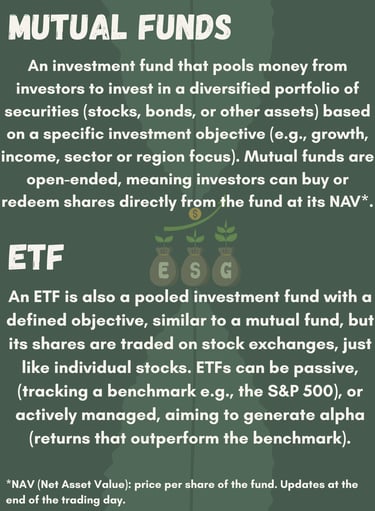
ESG Mutual Funds
Identifying green investment funds
1) Fund Name: The fund name is the first indication of the focus of the fund. They're long enough to give you a hint of where to look into, however, it's not the main indication because of the discretionary manner in which investments are made. Examples of fund names include: Berenberg Sustainable World Equities, Nordea 1 – Global Climate and Environment Fund, Bloomberg MSCI Euro Corporate ESG Sustainability SRI, and so on.
2) EU SFDR: Under the SFDR, funds that integrate sustainability in their portfolios involve the investment in companies that are in the business of, or integrate, environmental solutions, have good governance and social practices, as well as social due diligence. SFDR has two main classifications for ESG related funds and these are Article 8 (light green) and Article 9 (dark green). Article 8 integrates ESG in investment decisions but puts financial performance ahead of sustainability, and is not as stringent as Article 9 which involves sustainability objectives as the primary investment objective. It is oriented towards impact investing. Article 9 has three requirements: have positive impact (environmental and social), do no harm, and have strong governance.
3) Labels: Labels in the corporate world include those of B-Corp, Ecovadis, ISO, and several others. For product-related labels there are labels from Rainforest Alliance, Fairtrade, etc. Similarly there are several firms in EU that provide labels for investment funds based on a pass-or-fail system or using a point system, both of which require a minimum threshold to be qualified for a label for ESG investing. These organisations can be formed in tandem with Government institutions, Stock Exchanges, Industry Associations or non-profits. Some labels are issued after review from an external reputable third-party auditor. Here's a list of organisations that provide eco-labels:
FNG-Siegel: https://fng-siegel.org
Label ISR: https://www.lelabelisr.fr
LuxFLAG ESG: https://luxflag.org/labels/esg/
Nordic Swan: https://www.nordic-swan-ecolabel.org/criteria/investment-funds-and-investment-products-101/
Towards Sustainability: https://towardssustainability.be
Umweltzeichern Ecolabel: https://www.umweltzeichen.at/de/produkte/finanzprodukte
4) Rating: Ratings are an aspect where an investor needs to be proactive with knowing what the rating means because different rating agencies provide different scores based on different criteria and methodology. It's not a uniform standard and is not easily comparable between different rating agencies. The following is a list of Rating agencies:
Morningstar Sustainalytics: https://www.sustainalytics.com/investor-solutions/analytic-reporting-solutions/morningstar-esg-risk-rating-for-funds#morningstar
MSCI ESG Ratings: https://www.msci.com/data-and-analytics/sustainability-solutions/esg-ratings
ISS ESG Fund Rating: https://www.issgovernance.com/sustainability/fund-rating/
5) Investor Documents: Funds will have a prospectus, key investor information document, sustainability report, fund investment log, and published historical performance. These documents give insights into investment objective which could be based on an ESG investment strategy, selection and portfolio construction, type of investments excluded from the fund e.g. fossil fuels industry, detailed investment screening and ESG metrics evaluated, and the benchmark fund it is measured against.
Green Bonds and Social Bonds
Green bonds and social bonds offer investors an opportunity to invest in fixed-income investments that are dedicated to investing in environmental or social causes. A combination of green bonds and social bonds can also be known as Sustainability bonds. These bonds can be issued by governments and municipalities, banks, supranational entities, and corporations.
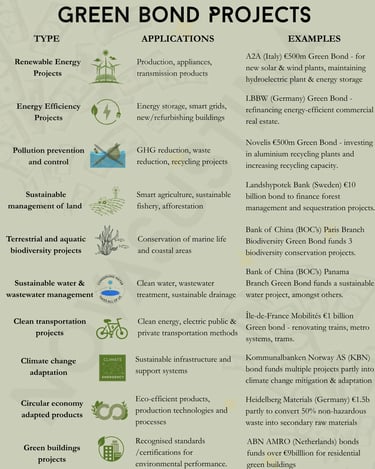
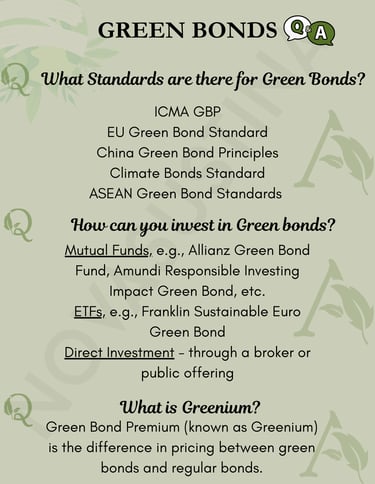
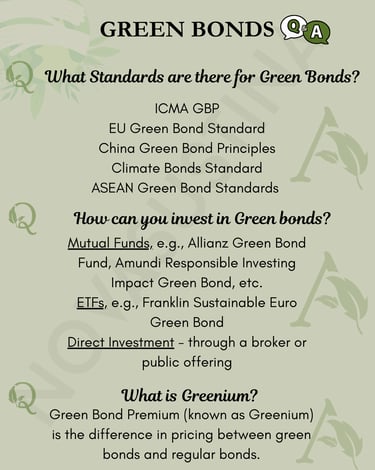
Green bonds can be used to fund different types of projects such as renewable energy development, energy efficiency and storage, pollution prevention, sustainable agriculture, biodiversity protection, sustainable water management, clean transportation projects, climate change mitigation projects, product circularity and recycling projects, and green building projects, amongst others. The International Capital Market Association (ICMA) released guidelines on how green bonds should be structured in accordance with Green Bond Principles (GBP), which report on the characteristics of the bond and predetermined project types. Green bonds issued with ICMA reporting guidelines will carry four sections with transparency:
Use of proceeds - description of project types proposed, e.g., energy storage solutions and renewable energy projects (can be many different types).
Process for project evaluation and selection - describing the sustainability objectives, process for selection of eligible projects, members or teams involved in the process, external reviews or internal reviews ,and the frequency of these reviews, resolutions in case of doubt, and risk management process.
Management of proceeds - funding received should be tracked by the issuer in a register and managed under a 'bond-by-bond approach' or 'portfolio approach'. These should be reflective of allocations made to the different projects. Transparency should be there on the temporary placement of unallocated funds.
Reporting - An annual report on a timely basis should report on the impact, material developments, the list of projects and their fund allocations, a description of projects, and expected impact.
Quality of green bonds can be assessed by information issued from 'Second-party opinions' or an 'External reviewer'. These can be from the following organizations:
Sustainalytics (a Morningstar Company)
ISS ESG (part of Institutional Shareholder Services)
S&P Global Ratings Ltd
Sustainable Fitch
Moody's Ratings
Also includes the big global consulting and auditing firms.
Green bonds can also receive a certification from the Climate Bonds Initiative (CBI) Standard or from CICERO and DNV.

Social Bonds focus on projects that solve existing social needs and can improve societal living conditions. Projects involve:
Building or improving infrastructure and making it accessible and affordable e.g. transportation, clean water etc.
Access to healthcare, education, and financial services.
Affordable housing.
Projects focused on food security.
Projects aimed at empowering citizens and increasing employment.
Examples of a social bond fund: IFC Social Bond and Fidelity Funds 2 - Social Bond Fund
Disclaimer: Any stated examples of bonds, funds, or investment options do not constitute investment advice or recommendations. They are noted purely as examples for educational purposes.
Sources
https://www.finra.org/investors/investing/investment-products/mutual-funds#overview
ICMA Green Bond Principles - Voluntary Process Guidelines for Issuing Green Bonds, June 2025
Thierry Roncalli, Handbook of Sustainable Finance, 2025
Offenlegung
Diese Website versendet keine E-Mail-Benachrichtigungen, Newsletter oder unaufgeforderte Abonnementanfragen. Die Kontaktaufnahme erfolgt ausschließlich über das Kontaktformular, das eine direkte Kommunikation per E-Mail für Interessierte ermöglicht.
Alle Nutzer werden gebeten, unsere Allgemeinen Geschäftsbedingungen zu lesen.